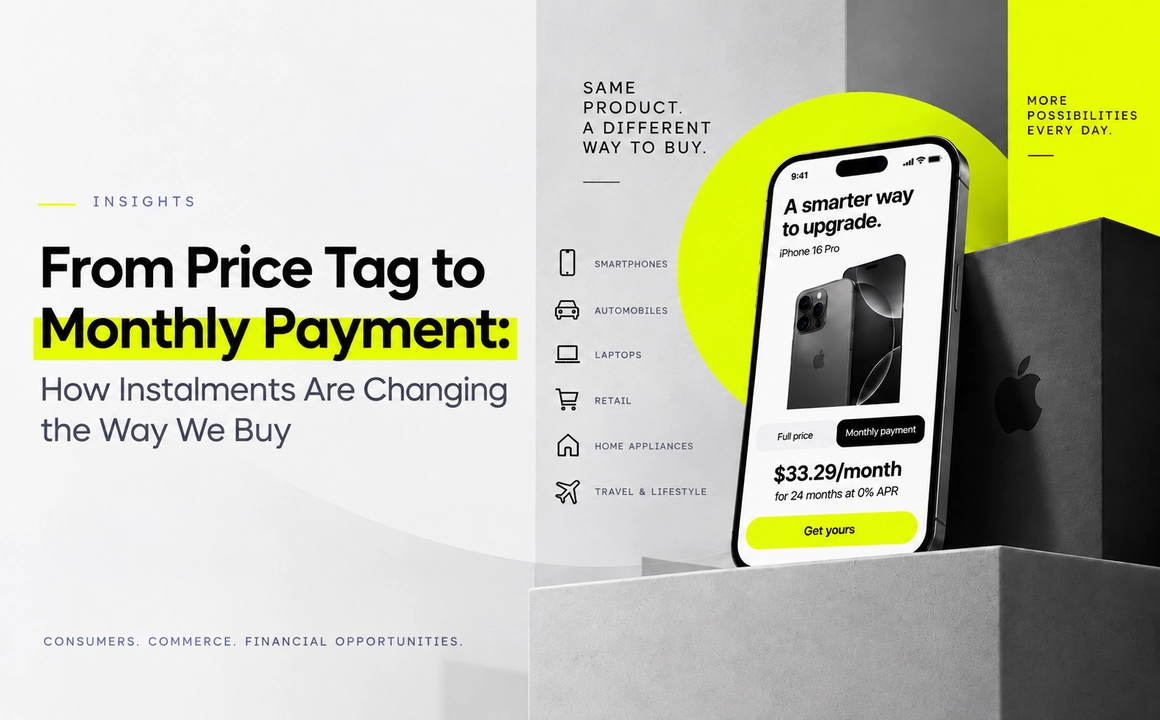
For decades, buying a car in North America has come with a familiar question. Not simply: How much does it cost? But: What is the monthly payment?
A car may carry a $50,000 price tag, but for many buyers the number that ultimately defines affordability is $650, $750 or $900 per month. Financing has become so deeply embedded into automotive commerce that the monthly payment is effectively part of how the product is priced, marketed and compared.
Now, something similar is happening to another product that has become essential to everyday life: the smartphone.
And smartphones may be just the beginning.
Look at the way some of the world's biggest technology companies are selling their flagship products today.
On Apple's U.S. store, an iPhone isn't presented only with its full retail price. Apple currently advertises iPhone from $699 or $29.12 per month for 24 months through Apple Card Monthly Installments. Customers can also finance an iPhone through participating carriers over 24 or 36 months at 0% APR, with the payment incorporated into the regular carrier bill.
More interestingly, Apple has gone further than conventional instalment financing.
In July 2026, it launched Apple Upgrade, a Klarna-powered leasing program for iPhone, iPad, Mac and Apple Watch in the United States. Instead of buying the device outright, eligible customers can make monthly payments and upgrade at the end of the lease. Apple launched the program with iPhone leasing starting from $17.99 per month, depending on model and term.
The significance isn't simply that Apple has another financing option. It is the way the proposition is communicated.
Apple's current financing pages repeatedly bring the consumer back to the monthly number: trade in an existing device and pay even less per month; choose a lease term; finance through Apple Card; finance through the carrier.
Google does much the same. The Google Store currently presents the Pixel 10 Pro at $999 or $27.75 per month with 36-month financing. The monthly payment appears directly alongside the retail price rather than being hidden as an alternative somewhere at the end of checkout.
Samsung provides another example. Its Canadian Galaxy S26 Ultra store page displays both the full device price and its equivalent monthly payment, including 24-month 0% APR instalment options. Samsung Canada has also introduced an Annual Upgrade Program built around monthly payments and the ability to upgrade every year or two.
Three of the world's largest smartphone ecosystems are therefore doing something very similar: turning financing from a checkout mechanism into part of the product proposition itself.
It is tempting to describe all of this as another chapter in the growth of Buy Now, Pay Later.
But I think that misses the more interesting trend.
What we are seeing is a broader pay-over-time economy, with different financial models converging around one consumer expectation: I want the product now, but I want the cost structured around what I can comfortably pay over time.
That can take many forms.
It can be a classic Pay-in-4 BNPL. It can be a 12-, 24- or 36-month installment loan. It can be a revolving credit line. It can be device financing from a telecom operator. It can combine financing with a trade-in. Or, as with Apple's new program, it can be a lease designed around regular upgrades.
The financial mechanics behind these products are very different.
From the customer's perspective, however, they solve essentially the same problem: converting a large upfront purchase into a manageable recurring commitment.
And once customers become accustomed to evaluating products this way, the competitive dynamics of retail begin to change.
Imagine two retailers selling exactly the same flagship smartphone for exactly the same retail price.
One offers a traditional checkout.
The other tells the customer immediately what the monthly payment could be, determines eligibility almost instantly, provides several repayment options, allows the customer to trade in an existing device, completes the financing inside the same purchase journey and makes future repayments simple to manage.
Technically, they are selling the same phone.
Commercially, they are offering two very different products.
This is precisely the shift that Ukrainian electronics retailer Citrus has been discussing. Its CEO recently argued that the premium smartphone market is increasingly moving away from the logic of “how much does the phone cost?” and toward “what will my monthly payment be?”
The point is important because it comes from the retailer's perspective.
When instalments become a standard way to purchase rather than an occasional promotional tool, competition moves beyond who has the lowest price on the shelf.
The winners also need to compete on:
how understandable and attractive the monthly payment is;
how flexible the instalment structure is;
how quickly financing can be approved;
how little friction financing adds to checkout;
how easily customers can manage and repay it; and
how naturally financing fits into the overall customer experience.
In other words, financing itself becomes part of merchandising.
That has an interesting consequence.
Financial services no longer need to begin inside a bank.
Consider telecom operators.
Telcos have traditionally been among the most natural providers of device financing because the customer already has a recurring billing relationship with them. Apple explicitly supports carrier financing at its own checkout, allowing eligible customers to spread an iPhone over 24 or 36 months and pay through their carrier bill.
But once a telco can finance a $1,000 smartphone, there is an obvious strategic question: why should the financial relationship stop with the smartphone?
The same logic applies to retailers.
An electronics retailer already controls product discovery and checkout. A supermarket or retail group may have millions of loyalty members. A marketplace may have both consumers and merchants inside the same ecosystem. A fuel network may have a highly active app, loyalty program and frequent payment interactions.
These companies are not necessarily trying to become banks.
But they increasingly have reasons to add financial capabilities to the customer relationships they already own.
Device financing can lead to instalments on other purchases. Instalments can lead to reusable customer credit limits. A credit line can sit alongside a wallet. The wallet can connect payments and loyalty. Financing can become personalized using the customer's existing relationship with the business.
The boundary between commerce, customer engagement and financial services starts becoming much less visible.
There is a paradox here.
As financing becomes more sophisticated behind the scenes, it needs to become simpler in front of the customer.
A shopper does not want to feel that they have left a smartphone purchase and entered a loan-origination process.
They want to choose a device, understand the monthly payment, confirm a few details, receive a decision and finish the purchase.
Samsung's current financing journey illustrates the expectation well: customers can select financing at checkout, provide the required information, receive an instant eligibility decision and then complete their purchase.
The better embedded finance becomes, the less it feels like a separate financial product.
But making it feel that simple requires considerable technology underneath.
A seamless instalment purchase can involve an entire lending infrastructure.
First comes customer identification and onboarding. Depending on the market and product, this can include KYC, identity verification, AML checks, consent management and integration with local identity providers.
Then comes eligibility.
For an existing customer, the company may already know considerably more than a traditional lender would know about a new applicant: payment history, tenure, product usage, purchases, loyalty activity or account behaviour. That information can potentially complement traditional credit data, subject to the applicable consent, privacy and lending rules.
Eligibility may also need to be continuously re-evaluated. A customer who was eligible six months ago may not have the same available limit today.
Then comes decisioning: gathering relevant data, applying credit policies and affordability rules, calculating a score or risk category, assigning a limit and returning a decision quickly enough that the customer does not abandon the purchase.
The financial product itself has to be configured: down payment, number of instalments, interest or fees where applicable, credit limits, payment dates, merchant economics and local calculation rules.
Once approved, the system needs to create and service the agreement.
Then come payments and repayments: cards, direct debit, bank transfers, wallets, automatic collections or, in the telco case, potentially the customer's existing billing relationship.
Behind that sit ledgering, reconciliation, notifications, refunds, early repayment, failed payments, delinquency handling, customer support, reporting and audit trails.
And all of this needs to integrate with the systems the enterprise already has: CRM, billing, mobile applications, payment providers, banks, credit bureaus, KYC vendors, loyalty engines and accounting systems.
The customer sees:
€49/month. Buy now.
The infrastructure underneath can involve dozens of processes and integrations.
That difference between front-end simplicity and back-end complexity is what makes this market particularly interesting.
North America offers an obvious reference because consumers have long been familiar with monthly-payment thinking, particularly in automotive and telecom.
But we are increasingly seeing the same discussion elsewhere.
At Neofin, some of the most interesting conversations we are having today are in Central and Eastern Europe and the Middle East.
The market structures are different, as are regulation, credit infrastructure, payment behaviour and customer expectations. The product that works in Canada or the United States cannot simply be copied into Poland, Albania, Romania, Saudi Arabia or another market.
But the business question is becoming remarkably similar:
How can an enterprise with a large existing customer base add financing and financial services without building a fintech company from zero?
And increasingly, the companies asking that question aren't only banks or lenders.
They are telecom operators, retailers, diversified groups and other businesses that already own frequent customer interactions.
For them, the opportunity isn't necessarily to launch another standalone financial application.
It is to make finance a native part of the ecosystem customers already use.
This is also where our thinking at Neofin has evolved.
We don't believe every retailer or telco entering this space needs another rigid, off-the-shelf lending platform. Nor does it make sense for most enterprises to spend years recreating all the financial technology underneath the customer experience.
There is a middle ground.
We combine proven Neofin technology for onboarding, lending, decisioning, servicing, payments, wallets and customer experiences with custom engineering around the enterprise's actual business model and existing technology.
That distinction matters.
The financing journey of a telecom operator may need to interact with subscriber data, billing and device sales. A retailer may need financing embedded directly into checkout and loyalty. A diversified group may want one reusable credit relationship across several brands. Different markets may require completely different KYC providers, credit bureaus, payment methods or regulatory reporting.
So the objective shouldn't be to force every business into the same predefined product.
It should be to reuse what is already proven, integrate what already exists and custom-build what makes that particular customer experience different.
Keep what works. Integrate what's needed. Build what's missing.
That approach is becoming particularly relevant as financing moves closer to the point of purchase.
The full price of a smartphone isn't going away.
Neither are traditional payment methods.
But the way consumers understand affordability is clearly becoming more flexible.
When Apple presents a product through leasing, monthly instalments, carrier financing and trade-ins; when Google puts a 36-month payment next to the Pixel's retail price; and when Samsung builds monthly payments and annual upgrades directly into the device proposition, these aren't simply alternative ways to settle a transaction.
They influence how the customer evaluates whether to make the purchase at all.
And that creates a significant shift for the companies selling high-value products.
Tomorrow's winner may not simply be the retailer with the right smartphone in stock, the telco with the strongest network or the marketplace with the lowest listed price. It may increasingly be the company that makes an expensive product feel accessible, understandable and effortless to buy.
For a growing number of purchases, the price tag will still matter.
But the number that closes the sale may be the one followed by:
“per month.”