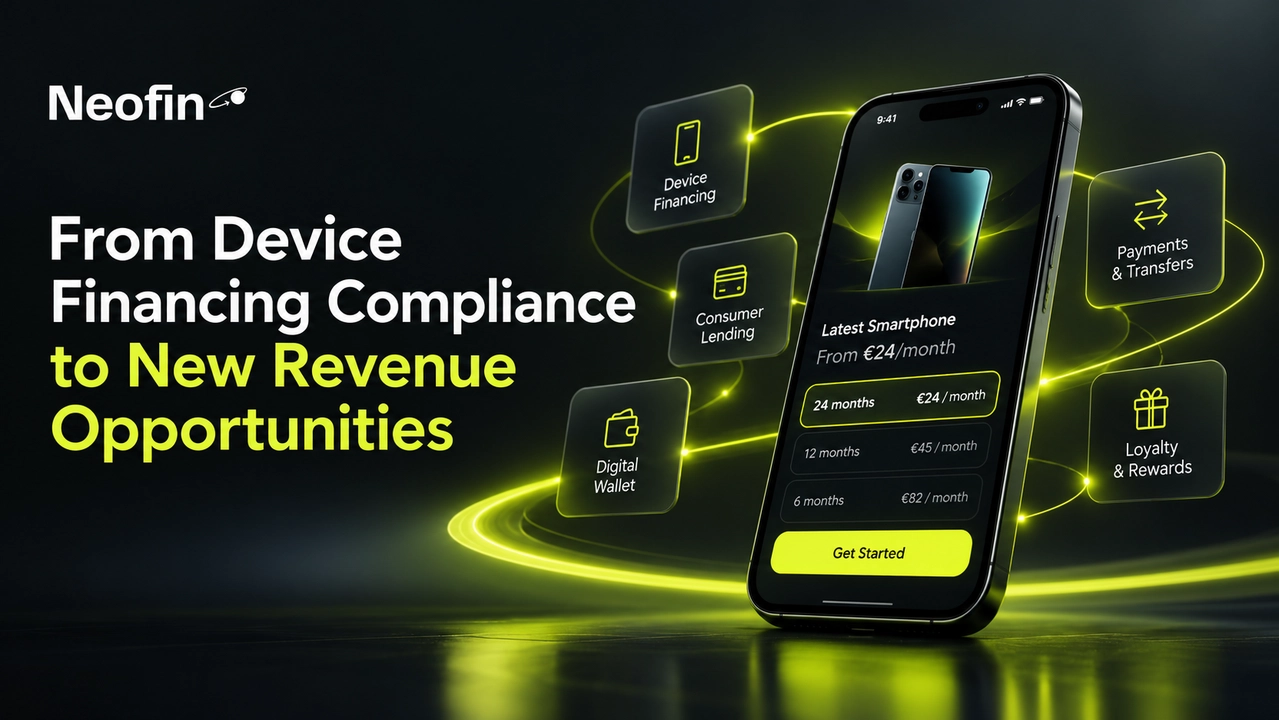
How the revised EU Consumer Credit Directive is reshaping telecom device financing — and why the response could become a foundation for embedded financial services.
For years, European telecom operators have offered consumers a convenient way to purchase expensive smartphones and other devices: pay for the hardware in monthly instalments, often interest-free, alongside a mobile subscription. The model is familiar to customers and commercially important to operators. It makes premium devices more accessible, supports hardware sales and helps telecom businesses maintain long-term customer relationships.
However, the regulatory framework surrounding these arrangements is changing.
On 20 November 2026, the revised EU Consumer Credit Directive (CCD2) becomes generally applicable across European Union Member States. Its expanded scope brings many previously excluded consumer-financing arrangements, including certain interest-free instalment products, within the consumer-credit regulatory framework.
For telecom operators, this creates a practical challenge. How can a business that has traditionally managed device instalments through its commercial and billing infrastructure adapt to consumer credit requirements involving affordability assessments, disclosures, credit decisions, servicing and regulatory oversight? And perhaps more importantly, can the technology investment required for CCD2 become something more valuable than a compliance expense?
The answer depends on how operators approach the transition.
CCD2, formally Directive (EU) 2023/2225, was adopted in October 2023 to modernize European consumer credit legislation. It replaces the original Consumer Credit Directive 2008/48/EC and reflects the evolution of consumer lending, particularly the growth of digital credit, Buy Now, Pay Later (BNPL) and alternative financing arrangements. The directive aims to strengthen consumer protection by expanding regulatory coverage and introducing more comprehensive requirements around creditworthiness, transparency, responsible lending and customer rights.
One of the most consequential changes is the treatment of interest-free credit. Under the previous directive, several categories of financing were excluded, including certain interest-free agreements and loans below €200.
CCD2 significantly narrows these exclusions. This means that a financing product does not necessarily fall outside consumer-credit regulation just because it carries no interest. For example, a smartphone offered through 24 monthly instalments may fall within the scope of consumer-credit legislation even if the operator charges no financing fee. Certain narrowly defined deferred payment arrangements remain excluded under CCD2, but operators should not assume that these exemptions cover conventional long-term device financing.
The critical question is no longer whether an operator charges interest. It is whether the specific financing arrangement constitutes regulated consumer credit under the applicable national framework.
Importantly, CCD2 is an EU directive implemented through national legislation. Operators with activities in several European countries must assess the requirements market by market.
Telecom operators already manage millions of recurring customer payments. Many also have sophisticated customer databases, digital onboarding processes, risk scoring mechanisms and automated billing systems.
However, managing recurring payments is not the same as operating a regulated consumer credit product. Consider a typical device financing journey. A customer selects a smartphone, chooses a 24-month payment plan, signs an agreement and starts paying monthly instalments.
Traditionally, the operator might assess eligibility using existing customer information, payment history and internal commercial policies. For products falling within CCD2, this approach may no longer be sufficient. Depending on the applicable national requirements and financing model, the operator may need to introduce additional capabilities.
CCD2 strengthens the obligation to assess a consumer's ability to repay before concluding a credit agreement. Existing telecom payment behavior can potentially contribute to the assessment, but it does not automatically replace a comprehensive evaluation of relevant financial circumstances.
Operators may need to collect additional information, integrate external credit data providers and implement documented affordability policies.
Consumers must receive the required information about financing terms, costs, repayment obligations and relevant rights. These requirements affect how offers are presented in retail stores, websites and mobile applications. Operators need to ensure that financing remains understandable without creating unnecessary complexity in the purchasing journey.
Automated credit decisions may require additional transparency, appropriate explanations and mechanisms for human intervention or contestation, depending on the circumstances. This creates requirements not only for decision engines but also for operational workflows and customer support.
A regulated credit relationship extends beyond approval. Operators must consider repayment schedules, early repayment, withdrawal rights, payment difficulties, arrears handling and appropriate customer communications.
Credit-related activities may require documented policies, decision histories, operational records and, depending on the jurisdiction and business model, authorization or registration. For many operators, these capabilities do not fit neatly into existing telecom billing infrastructure. The result is a transformation involving Legal, Compliance, Finance, Risk, IT, Digital and Commercial teams simultaneously.
The regulatory impact on telecom operators is not theoretical.
In June 2026, the American Chamber of Commerce in Croatia met with the Croatian Ministry of Finance to discuss the implementation of the new Consumer Credit Act. The discussions specifically addressed interest-free instalment sales of mobile devices offered by telecommunications operators. Representatives of Hrvatski Telekom, A1 Croatia and Telemach Croatia participated. Among the issues discussed were creditworthiness assessments, proportionality of regulatory requirements, administrative obligations and the time needed to adapt business processes and IT systems. Further discussions with Croatian authorities followed in September 2026.
The example illustrates an important point: CCD2 implementation is not simply a question of updating consumer contracts. It can require significant changes to the underlying financing infrastructure.
Croatia also demonstrates why operators must examine national implementation timelines carefully. While the general EU application date is November 2026, Croatia has introduced transitional provisions for certain newly regulated creditors and intermediaries, including dates extending into 2027.
These arrangements are specific to the applicable legal categories and should not be interpreted as a blanket extension of CCD2 obligations. For telecom groups operating across several European markets, a coordinated but locally configurable approach is therefore essential.
The first step should not be selecting a technology vendor or rebuilding a customer application. It should be understanding which existing financing activities are affected and what operating model the business wants to maintain.
We recommend beginning with four questions:
Which products are affected?
Operators should review device instalments, hardware financing, upgrade programs, deferred payments, bundled subscription arrangements and any third-party financing offers. Each product may have different contractual and regulatory characteristics.
Who is legally providing the credit?
Some operators finance devices directly. Others distribute products funded by banks or specialist lending institutions. The distinction affects credit-risk ownership, regulatory permissions and operational responsibilities.
Which capabilities already exist?
Telecom businesses may already have identity verification, customer data, billing, payment collection and internal scoring infrastructure. The objective should be to reuse appropriate existing components rather than automatically replace them.
What is the longer-term business objective?
Is the priority to preserve current smartphone financing, or does the operator also want to introduce more flexible financing products, partner commerce or additional financial services? The answer should influence the technology architecture from the beginning.
A practical implementation approach should cover the entire credit lifecycle rather than focusing exclusively on creditworthiness assessment.
The following mapping can help telecom teams translate regulatory requirements into operational and technology workstreams.
These capabilities do not independently guarantee legal compliance. Their configuration and operation must reflect the applicable national requirements, product design and regulatory responsibilities. However, they provide a practical foundation for implementing those requirements consistently.
Creditworthiness is likely to be one of the more demanding operational changes for operators accustomed to simplified device eligibility checks. A structured assessment may require information from several sources:
Existing customer payment history and account data, where lawful and relevant.
Customer-provided income, expenditure and financial information.
Credit-bureau information, where available and permitted.
Open-banking information, where appropriate and lawfully accessed.
Product-specific affordability and eligibility policies.
These inputs need to be combined into a decision that is consistent, explainable and properly documented. For operators serving large customer bases, manually reviewing every application may create significant operational pressure. Configurable credit decisioning infrastructure can help automate appropriate parts of the process while retaining escalation paths for exceptions and human review.
The objective is a responsible, repeatable and auditable credit assessment.
One of the most important architectural decisions is whether credit capabilities should be embedded directly into existing telecom systems or introduced through a dedicated financial-technology layer. Many telecom operators already have substantial investments in customer-facing applications, authentication, CRM, billing and digital commerce. Replacing these systems to accommodate CCD2 would often be unnecessary and disruptive.
An alternative is to introduce modular credit infrastructure behind the existing customer experience.
Under this approach, the telecom operator retains control over its mobile application, website, product catalogue and customer relationships. A dedicated financial layer manages credit-specific functions, including origination, decisioning, agreement management, servicing, collections and reporting. Specialist partners provide additional capabilities such as credit-bureau access, identity verification, electronic signatures, payments or regulated lending. These components communicate through APIs and integration services.
For the customer, the financing journey can remain inside the familiar telecom application. For the operator, credit processes become more structured and configurable without requiring a complete replacement of its digital ecosystem.
Consider a customer purchasing a smartphone through an operator's mobile app. The customer selects the device and requests an instalment offer. Behind the scenes, the credit infrastructure manages eligibility checks, required information collection, creditworthiness assessment and the generation of appropriate financing terms. Once the customer accepts the offer and completes the required agreement process, the financing account is created.
Repayment information and account status can then be displayed through the operator's existing application, with the underlying credit system managing the financial lifecycle. This model is what Neofin recommends for enterprise lending infrastructure. Rather than requiring telecom operators to adopt a separate consumer application, Neofin provides configurable credit capabilities that can integrate with existing channels, billing systems, data providers and financial partners. The architecture can also support different implementation approaches: API-based integration, selected embedded customer journeys or joint development with the operator's existing technology team.
Not necessarily.
CCD2 may encourage operators to reconsider who should originate, fund, manage and bear the risk of consumer-financing products. There are three broad operating models to evaluate.
The operator maintains a direct financing relationship with customers, subject to applicable regulatory permissions. This provides greater control over financing economics and product design but also creates responsibilities involving credit risk, governance, servicing and potentially funding.
A licensed financial institution provides the credit while the telecom operator manages distribution and the customer-facing commercial experience. This may reduce certain financing and regulatory burdens for the operator, although its own responsibilities must still be assessed.
The operator combines different financing arrangements depending on the product, customer segment or market. For example, device instalments could follow one operating model while personal loans or merchant-financed purchases are delivered through regulated financial partners.
A modular financial architecture can support these alternatives without requiring a separate technology stack for every product. The key is a clear allocation of responsibilities. The telecom operator may own customer engagement and distribution. A regulated financial partner may provide funding and assume credit risk. A technology provider may deliver origination, decisioning and servicing infrastructure. This division should be reflected in the contractual, operational and regulatory framework.
For telecom executives, the immediate CCD2 business case is often defensive: protect device-financing operations and avoid disruption. Still, the capabilities introduced for compliance can also support future products. A financing platform capable of assessing customers, managing credit limits, generating agreements and servicing repayments is not inherently limited to smartphone purchases. The same foundation can support multiple propositions, subject to appropriate product configuration, regulatory permissions and risk controls.
Operators could explore different instalment periods, device-upgrade financing, refurbished-device programs, trade-in arrangements and revolving purchasing limits. Instead of creating a new operational process for every proposition, these products could share common origination, decisioning and servicing capabilities.
Telecom operators increasingly participate in broader consumer ecosystems involving electronics, accessories, digital services and retail partnerships. A reusable credit infrastructure could support instalment offers across selected merchant channels. This creates opportunities for new commercial partnerships and potentially additional financing-related revenue, depending on the operating model.
Operators with established customer relationships and digital distribution may explore personal loans, purpose-based financing or revolving credit through appropriately authorized structures. Existing customer channels could become distribution points for financial products, while dedicated lending infrastructure manages the underlying processes.
A longer-term opportunity is to connect financing with payments, digital wallets and customer loyalty. For example, a customer could access eligible financing offers, manage repayments and interact with merchant rewards through a unified digital experience. Such ecosystems involve additional regulatory considerations beyond CCD2, particularly around payments and electronic money.
Nevertheless, the underlying technology capabilities can be designed to support future expansion.
Building a credit capability is more complex than introducing a scoring engine. It requires coordinating customer journeys, risk policies, external data, agreement workflows, repayment processing, servicing, regulatory controls and existing enterprise infrastructure. In telecom environments, these systems must also operate at scale and integrate with established platforms.
Experience with end-to-end financial implementations therefore matters. For example, Neofin's work on an embedded-finance ecosystem for a major telecom customer has involved designing digital financing journeys, BNPL and instalment products, credit decisioning using more than 150 attributes, loan management, collections and integration with enterprise infrastructure.
The project illustrates how financing capabilities can be introduced into a broader telecom ecosystem rather than developed as isolated applications. Neofin's wider platform combines loan origination, underwriting, servicing, collections, payment capabilities and integration infrastructure, supported by an implementation team with experience across financial-services projects.
With CCD2 approaching, operators should treat readiness as a coordinated cross-functional initiative.
A practical roadmap consists of five stages:
Stage 1: Regulatory and product mapping
Identify affected financing products, applicable national requirements, potential exemptions, authorization obligations and transitional arrangements. Establish the roles of Legal, Compliance and external financial partners.
Stage 2: Gap analysis
Review existing customer journeys, eligibility checks, credit policies, contracts, billing processes, collections and reporting. Identify which capabilities can be reused and where additional technology or operational controls are needed.
Stage 3: Operating-model design
Decide who provides credit, owns risk, manages customer interactions and performs servicing. Confirm the target responsibilities of the operator, regulated partners and technology providers.
Stage 4: Technology integration
Introduce the required credit capabilities through existing systems or modular financial infrastructure. Prioritize configurable workflows, API integration, auditability and the ability to adapt to different national requirements.
Stage 5: Testing and rollout
Validate the complete financing journey, including disclosures, creditworthiness assessments, agreement execution, repayments, exceptions and customer support. Complete the necessary legal and compliance reviews before launching affected products.
For operators working against near-term deadlines, some stages may need to proceed in parallel. The objective should be a compliant and commercially sustainable operating model, not merely the delivery of individual technical features.
CCD2 represents a significant regulatory change for European telecom operators offering device financing and other consumer-credit products. The immediate priorities are clear: understand the applicable national rules, assess existing financing arrangements and implement the necessary customer-protection and operational controls. The response, however, does not have to end with compliance.
The technology required to manage creditworthiness, origination, servicing and customer rights can also become a reusable financial-services capability. With the right architecture, operators can preserve their existing customer experience, integrate regulated financial partners and develop new financing propositions without rebuilding their entire digital ecosystem.
At Neofin, we believe the most valuable approach is to treat CCD2 readiness and long-term financial-product strategy as connected decisions.
The regulation may create the immediate reason to modernize device financing. The resulting infrastructure could enable the next generation of telecom financial services.
This article is intended for informational purposes and does not constitute legal advice. CCD2 requirements and their application to specific telecom products must be assessed under the relevant national legislation.